


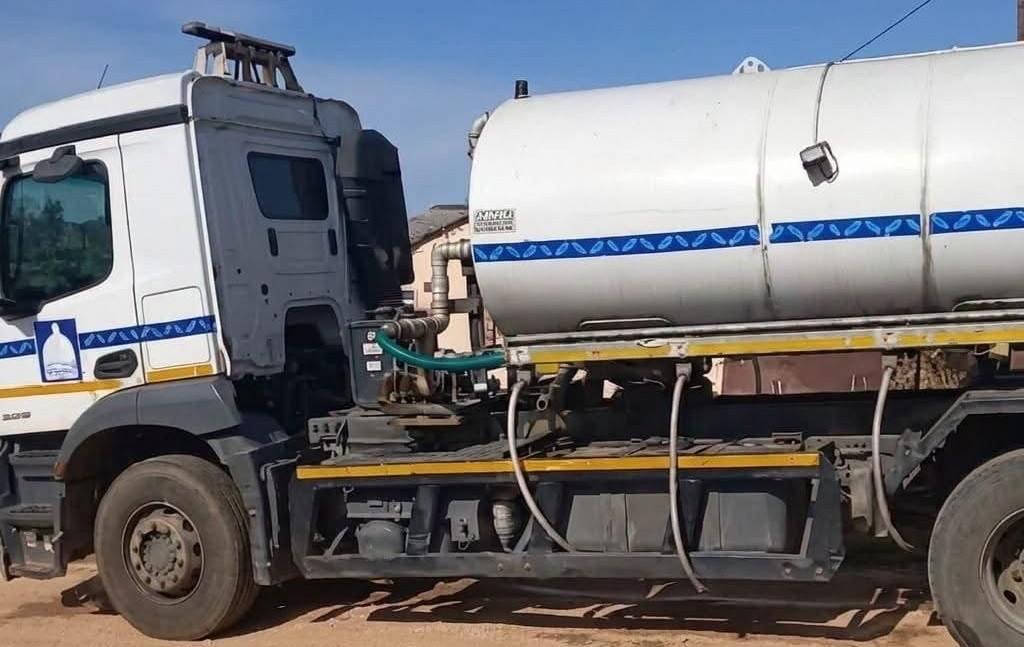
- Water tankers were intended as temporary emergency measures but have become a long-term substitute for functioning municipal infrastructure.
- South African municipalities are spending billions on tanker services while leaks, theft and infrastructure failures continue to escalate.
- The author argues that constitutional intervention powers exist but are not being applied consistently or measured against measurable water-service outcomes.
In Adams Mission, KwaZulu-Natal, a community resident, Celani Zungu, was killed by the driver of a municipal water tanker. Footage of the incident has gone viral on social media. An investigation is under way.
Whatever it finds about the specific circumstances of his death, the system that put him beside that tanker in the first place needs no investigation. It has been visible, and unaddressed, for years.
In 2024, GroundUp documented drivers contracted to deliver free municipal water in this same community instead selling it, R500 for 5,000 litres, from a company operating under a municipal tender. The municipality said it would investigate. The tankers kept running.
Emergency relief becomes permanent infrastructure
According to South Africa’s Constitution, everyone has the right of access to sufficient water. To give practical effect to that right, particularly during infrastructure failures, repairs or planned maintenance, municipalities may deploy water tankers as a temporary emergency measure.
Water tankers were designed to serve as a bridge, not a substitute for functioning infrastructure. Yet delivering water by tanker costs up to 20 times more than supplying it through a piped reticulation system.
Despite this, many communities have become increasingly dependent on tankers as their primary source of water, reflecting not the success of emergency relief, but the failure of municipal water governance.
The City of Tshwane alone spent R777 million on tanker services in 2024/25, after R116 million the year before, mostly in areas hit by repeated bursts and suspected sabotage.
Nationally, the Auditor-General told Parliament in December 2025 that 59 municipalities, more than a fifth of the country’s 257, spent R2.32 billion on water tankering in the 2023/24 financial year alone. R419 million of that was irregular expenditure.
The arithmetic no longer makes sense
Already, billions in litres and rands are lost through leaks. Piped water is cheaper than trucked water. Municipalities keep buying trucked water anyway, at a scale that keeps growing rather than shrinking.
Either these institutions are too broken to notice the arithmetic, or somebody is profiting from ignoring it. Both readings converge on procurement.
In Johannesburg, an amaBhungane investigation uncovered evidence of potential collusion and manipulation behind a R263 million, three-year tanker tender awarded to two companies run by men in their twenties with no relevant track record.
In December 2025, the High Court declared the tender invalid. Johannesburg Water appealed. The contract is still running.
Infrastructure collapse is already documented
The institutional decline behind it is not in dispute. The latest Green Drop and No Drop assessments show nearly half of South Africa’s municipal wastewater treatment works in a critical state, and almost half of treated water is lost through leaks, theft, metering failures or other inefficiencies before it earns a rand of revenue.
The Auditor-General’s most recent water-sector report put the resulting losses at close to R19 billion in a single financial year. South Africa already has legal mechanisms built for municipalities in this condition.
Section 139 of the Constitution allows provincial government to intervene where a municipality cannot fulfil an executive obligation. The Municipal Finance Management Act 56 of 2003 sets out how, and Section 63 of the Water Services Act 108 of 1997 allows the national minister to step in specifically on water services.
In practice, the water-specific power is hard to use in isolation because municipal water revenue flows into one consolidated municipal account. “Taking over” water services without taking over the council’s finances runs straight into the MFMA.
That legal awkwardness is not a reason for inaction. It is a reason the general Section 139 power matters more than it currently delivers.
The uMkhanyakude warning
KwaZulu-Natal has used Section 139(1)(b). In June 2025, the province placed uMkhanyakude District Municipality under intervention over its collapsing water services.
The intervention was withdrawn and converted into a non-enforceable Section 154 support intervention. Members of Parliament subsequently questioned the decision on record, asking why enforcement had been relaxed while several of the original triggers for the intervention remained unresolved.
The constitutional mechanism exists. It can be invoked. But the uMkhanyakude case raises an uncomfortable yet important question. Are interventions being eased before municipalities have demonstrably recovered?
What would actually change the pattern?
Here we are, two deaths this year, a documented shadow economy built on emergency contracts, and an intervention power that gets withdrawn before it finishes its job. Whether the commissioned inquest finds fault in the specific circumstances at Adams Mission changes nothing about that pattern.
What would change it is the treasury and provincial government treating Section 139 interventions as processes to be completed against measurable water-service outcomes, not political events closed once the immediate embarrassment has passed, and ring-fencing water revenue so a municipality cannot quietly fund the next emergency out of the same account that failed to fund the last repair.
Water delivered through functioning pipes remains the cheapest, safest option South Africa has. Every month a municipality substitutes it with trucks; someone is being paid for the substitution, and someone else is paying for it, increasingly, with their life.
Get your news on the go. Click here to follow the Conviction WhatsApp channel.
The opinions expressed in this article are solely those of the author and do not necessarily reflect the views of Conviction.co.za
