


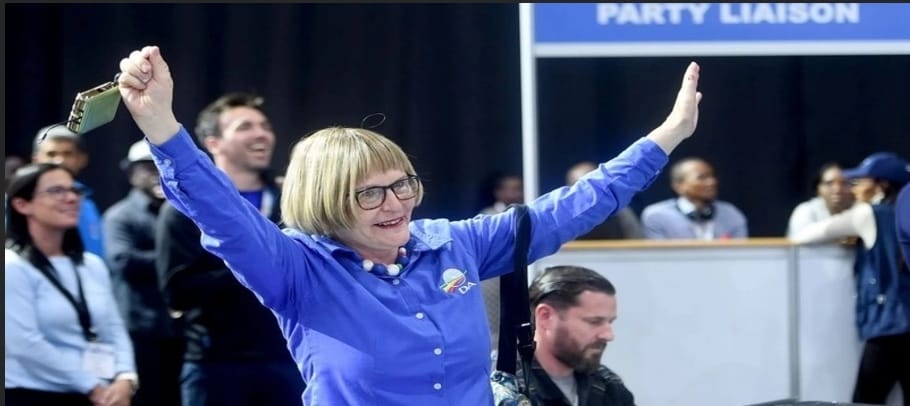
The Democratic Alliance (DA) returned from its US visit emboldened, declaring itself a “steadfast and credible advocate for South Africa’s national interests on the international stage” despite its junior role in the Government of National Unity (GNU).
The ANC asserted that foreign policy remains the “preserve of the executive,” exposing the fragility of South Africa’s fragmented governance system, which internal divisions and global right-wing shifts strain.
DA MP Willie Aucamp’s demand for ANC concessions on foreign policy, suggesting that the GNU’s Statement of Intent requires “sufficient consensus,” clashes with Minister Ronald Lamola’s defence of non-alignment as central to African sovereignty. However, the ANC’s hesitation to expel the DA reveals deeper contradictions: a ruling party tied to the very power structures it claims to oppose.
If indeed the “credible” DA truly crossed the line with its US visit, why hasn’t it been expelled from the GNU? This question underscores the deliberate contradictions that shape contemporary South African politics.
White privilege in the rainbow underpins the “new” South Africa
The enduring paradox of South Africa’s “rainbow nation” lies in its foundation: a negotiated transition that, while lauded for averting widespread conflict, ultimately preserved the very power structures that perpetuated inequality. Far from a mere political player, the DA is a key beneficiary and defender of these systemic privileges. Operating within a political system that tolerates its actions despite periodic outrage from other political factions, the DA can navigate a framework in the “new” South Africa that upholds deeply entrenched historical advantages.
The selective outrage in South African politics exposes the deep contradictions within the “new” nation’s ideals of equality. The same actors who criticise the DA for being racially insensitive usually remain silent when similar transgressions are committed by figures aligned with the dominant political narrative. This inconsistency underscores how entrenched power dynamics and patronage networks influence political discourse, where certain actors are held to vastly different standards based on their historical privileges.
The ANC’s handling of these contradictions is rooted in its politics of class collaboration, which has defined its governance strategy since the dawn of democracy. As Trevor Ngwane argues, the ANC has sacrificed the interests of the black working class to preserve an economic structure that disproportionately benefits white monopoly capital. This focus on elite consensus over genuine transformation is evident in ANC policies, such as its failure to implement radical land redistribution, reliance on private sector-led development and adherence to international financial institutions like the World Bank and the IMF.
This situation demonstrates leadership is more concerned with maintaining the status quo than effecting meaningful change. The GNU, rather than representing a decisive break from this well-established trend of elite accommodation, actually deepens it by incorporating the DA, a political party that openly and unapologetically defends the economic status quo and the interests of its predominantly white constituency, into the very heart of government.
The ANC, white privilege and assisted democracy in South Africa
Ngwane’s perspective offers a nuanced critique of the current political landscape in South Africa, highlighting the ANC’s role as the key architect and negotiator of the country’s post-apartheid political dispensation. According to this view, the ANC is inextricably bound to the DA and its strategic alliances with other organisations, such as AfriForum and Solidarity, representing the interests of conservative, racist groups that oppose integration. This entanglement, rather than fostering national unity, perpetuates a system where white privilege remains a central pillar of the “new” South Africa.
Far from promoting the creation of a genuinely inclusive national identity, this intricate web of political relationships cultivates a system in which the privileges linked to white dominance continue to exert considerable influence within the framework of the so-called “new” South Africa. Instead of dismantling the remnants of apartheid-era inequalities, the ANC’s entanglement effectively maintains a political and social order where the interests of conservative, racially exclusionary groups are preserved, thereby obstructing true national unity and perpetuating a societal structure that reinforces racial hierarchies. In this context, the ANC’s collaboration with such organisations impedes the transformation and genuine reconciliation many hoped for in the post-apartheid era.
South Africa’s transition to democracy in 1994 was not purely an internal achievement; external forces, including Western governments, international financial institutions and multinational corporations, facilitated it. This external assistance came with compromises, particularly in the economic and political spheres, which constrained radical transformation. Characterising as a “democracy born in chains”, Naomi Klein, much like many scholars, has pointed to the problems with the switch from apartheid to this much-revered democracy.
As Allister Sparks put it, “Before transferring power, the Nationalist Party wants to emasculate it. It is trying to negotiate a kind of swap where it will give up the right to run the country its way in exchange for the right to stop blacks from running it their own way.” As such, South Africa’s negotiated settlement under the sponsorship of global powers and bodies that supposedly ended apartheid preserved the dominance of the white minority elite and entrenched structural inequalities that persist today. The consequences of this externally assisted democracy include high unemployment, widening wealth disparities, white arrogance and industrial stagnation, disproportionately affecting the black population.
Politically, external pressures also extraneously influence South Africa’s policy decisions. This reality is further exacerbated by the rise of global right-wing populism, spearheaded by figures like Donald Trump, Jair Bolsonaro, Viktor Orbán, Javier Milei and Matteo Salvini. Trump’s engagement with South African right-wing groups, including AfriForum and the Suidlanders, exemplifies how external actors manipulate domestic affairs. In 2018, Trump boldly claimed that South Africa was seizing white-owned land and killing farmers, a narrative actively pushed by right-wing South Africans who thrive on the victimhood complex.
Despite the demise of apartheid, racial hierarchies endure in South Africa. WEB Du Bois famously declared that “the problem of the Twentieth Century is the problem of the color-line.” This remains relevant as racial inequalities continue to shape socio-economic conditions worldwide. Anti-black racism persists, and structures of inequality remain embedded within institutions, limiting opportunities for black people. South Africa, while being hailed a ”working” democracy, has yet to dismantle the economic and social privileges that apartheid conferred on the white population.
One of the paradoxes of South African history is its shift to apartheid, just as the West was moving away from direct colonial rule. This was mainly due to the historical contest between two settler classes: the British and the Afrikaners (Boers). Afrikaner identity developed in opposition to both black South Africans and Anglo whiteness. Even after apartheid, this historical dynamic persists, with Afrikaners seeking to redefine their identity in ways that sustain a sense of exclusivity and privilege.
Ordentlikheid, a concept deeply ingrained in Afrikaner identity, reflects this struggle. It signifies respectability, decency, and politeness but also preserves Afrikaner distinctiveness while integrating aspects of Anglo culture. This paradoxical dynamic illustrates the complexities of post-apartheid white identity in South Africa, where Afrikaners seek validation within the broader framework of white Anglo respectability while resisting complete assimilation or integration.
Opposition to the Expropriation and the BELA bills further underscores this tension, revealing a desire to protect perceived cultural and economic rights against historical dispossession and ongoing societal transformation. Trump’s continuous outrage and attacks on South Africa perpetuate a narrative of white victimhood that resonates deeply within specific Afrikaner communities, reinforcing their fears of losing cultural and economic privileges. This narrative not only fuels resistance to policies aimed at addressing historical inequalities but also reflects the broader challenge faced by post-apartheid South Africa in reconciling the legacies of racial privilege with the aspirations of a truly transformed society.
Apartheid aggressors promoted as victims under black-led democracy
Trump’s interventions in South Africa’s domestic affairs have fueled narratives of white victimhood. AfriForum and other right-wing groups have leveraged Trump’s rhetoric to gain international sympathy, perpetuating the false claim that white South Africans are facing “genocide”. This strategy aligns with broader white supremacist discourses that frame whiteness as under siege. Such narratives have political consequences, influencing policies like Trump’s executive order to withdraw aid from South Africa over the Expropriation Act.
This calculated strategy aligns seamlessly with broader white supremacist discourses that frame whiteness as perpetually under siege, a narrative that conveniently ignores the historical and ongoing realities of systemic racial inequality. Such narratives are not merely rhetorical; they have tangible political consequences, demonstrably influencing policies like Trump’s executive order to withdraw aid from South Africa over the proposed Expropriation Act, directly impacting the country’s developmental trajectory.
It must be emphasised that the concept of white victimhood is not a phenomenon unique to South Africa. It is a globally pervasive political tool deployed with remarkable consistency to position the white race as uniquely vulnerable despite their undeniable historical and ongoing socio-economic advantages. This narrative serves a specific and insidious purpose: to delegitimise black-led governance, undermine the legitimacy of democratically elected institutions and justify resistance to transformative policies aimed at redressing the enduring legacies of apartheid. This seeks to reverse the narrative of historical injustice and to portray the beneficiaries of apartheid as the new victims of a democratic context dispensation.
A fragile democracy and the enduring influence of historical privilege
What is apparent is that the DA continues to benefit from the power structures established during the negotiated transition. Despite periodic outrage, the DA functions within a system that tolerates its behaviour, underscoring the lasting influence of historical privilege. South Africa’s assisted democracy aptly captures the negotiated nature of the transition, which came at a significant cost—a cost that continues to manifest in persistent economic stagnation, simmering social unrest and deeply entrenched political contradictions.
The DA’s controversial visit to the US and the GNU’s noticeably muted response illustrates the persistence of these contradictions. The selective outrage surrounding the DA’s actions reflects a broader reluctance to confront and address the structural inequalities that continue to underpin South Africa’s political and economic order. Until these fundamental contradictions are faced with honesty and resolve, South Africa will remain a nation defined by deliberate inconsistencies, unfulfilled promises of transformation and the enduring apartheid past.
South Africa’s story is still being written. The question remains: Will it be a tale of liberation—or a cautionary fable of freedom bartered away?
Siya yi banga le economy!
#Conviction
