


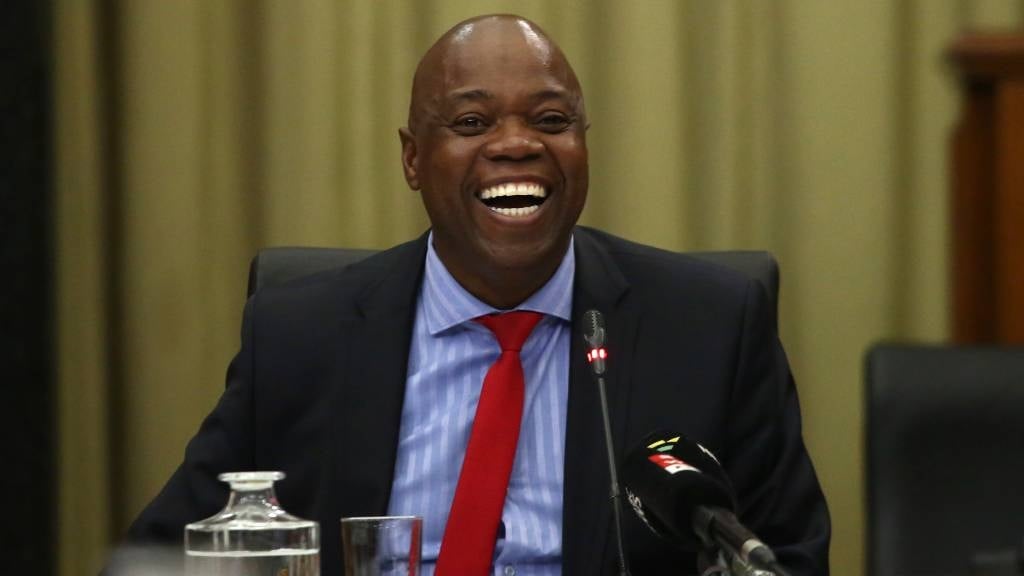
- Matric Luphondo failed in his bid to stop his corruption trial by challenging the authority of the prosecutors handling the case.
- The court found that the alleged errors in the High Court judgment did not meet the strict threshold required under Section 17(2)(f) of the Superior Courts Act to reconsider a refusal of leave to appeal.
- The judgment reaffirmed that when smaller and larger benches of the Supreme Court of Appeal disagree, the decision of the larger bench remains binding authority.
Former acting director of public prosecutions Matric Luphondo has failed in his attempt to challenge the authority of prosecutors handling his corruption case after the Supreme Court of Appeal dismissed his application to reconsider an earlier refusal of leave to appeal.
The ruling means that Luphondo will now have to face trial in the High Court in Pretoria, where he stands accused alongside Kebone Masange, a former head of department in the Mpumalanga provincial administration. The charges include seven counts of corruption and three counts of defeating or obstructing the ends of justice.
Luphondo’s challenge centred on whether the prosecutors conducting the case had the legal authority to do so. He raised a special plea in terms of Section 106(1)(h) of the Criminal Procedure Act, arguing that the prosecution had not been properly authorised under prosecution policy directives issued by the National Prosecuting Authority.
Background to the prosecution
The charges arise from allegations that Luphondo, Masange and an investigating officer acted together in an attempt to bribe a prosecutor who was handling Masange’s earlier criminal case involving fraud and immigration offences.
According to the State’s summary of substantial facts in the indictment, the group allegedly offered the prosecutor incentives to influence the outcome of that case. One of the alleged inducements included “gratification to wit a bottle of 18-year-old Glenfiddich whisky to the value of R1,550, and/or R5,000 in cash”.
During the criminal proceedings, it emerged that Luphondo had been the target of an undercover operation conducted in terms of Section 252A of the Criminal Procedure Act. A trial within a trial was held to determine the admissibility of evidence obtained during the operation.
It was during that process that Luphondo formed the view that his prosecution may not have been properly authorised and that the prosecutors conducting the case, therefore, lacked the authority to prosecute him.
The special plea
Luphondo subsequently raised a special plea under Section 106(1)(h) of the Criminal Procedure Act. He argued that the prosecutors had not obtained written authorisation from the Director of Public Prosecutions as required by prosecution policy directives issued by the National Director of Public Prosecutions.
In response, the State called the Director of Public Prosecutions for Gauteng, Andrew Mzinyathi, to testify. Mzinyathi confirmed that he had authorised the prosecution and that his decision had been communicated through a directive issued in terms of Section 75 of the Criminal Procedure Act.
Although he did not personally sign the directive, Mzinyathi testified that it had been issued on his instruction in accordance with standard practice in his office. He further confirmed that he had been briefed on the facts of the case before the decision to prosecute was taken.
The High Court ultimately rejected Luphondo’s special plea, finding that the prosecution had been authorised and that there had been substantial compliance with the prosecution policy directives.
Reconsideration application
After the High Court dismissed his special plea, Luphondo sought leave to appeal the decision. The High Court declined to hear his application for leave to appeal while the trial was still underway. Luphondo then approached the Supreme Court of Appeal directly.
Two judges of the Supreme Court of Appeal refused leave to appeal on the basis that there were no reasonable prospects of success. Luphondo subsequently applied for reconsideration in terms of Section 17(2)(f) of the Superior Courts Act.
That provision allows the President of the Supreme Court of Appeal to refer a refusal of leave to appeal for reconsideration where a grave failure of justice might otherwise result or where the administration of justice may be brought into disrepute.
Acting Judge T Makgoka emphasised that the threshold for reconsideration is deliberately high and reserved for exceptional circumstances.
“The applicant faces a formidable hurdle in establishing that the alleged errors were so gross as to make either outcome likely,” Judge Makgoka wrote.
No grave injustice established
Although the court acknowledged that the High Court had made certain errors in its reasoning, it held that those mistakes were not sufficient to justify reconsideration.
“The mere fact that a court has made an error is ordinarily not, in itself, a ground for reversing a lower court’s judgment,” Judge Makgoka wrote.
The court also rejected the argument that the absence of specific written authorisation invalidated the prosecution. Judge Makgoka said the purpose of the prosecution directives was to ensure that senior prosecutorial authorities were aware of and approved prosecutions involving certain categories of individuals, including prosecutors.
In this case, the court found that the Director of Public Prosecutions had been aware of and had approved the prosecution.
“Importantly, he approved the prosecution, thereby fulfilling the purpose of section 1 of Part 8 of the Prosecution Directives,” Judge Makgoka said.
Stare decisis clarified
The judgment also addressed the doctrine of stare decisis and the authority of previous decisions of the Supreme Court of Appeal.
Judge Makgoka explained that all judgments of the court carry the same status regardless of the number of judges on the bench. However, when conflicting decisions arise between a smaller bench and a larger bench, the decision of the larger bench prevails.
“The judgment of the smaller bench yields to the larger bench, and the latter is the binding authority in this Court,” Judge Makgoka wrote. The court warned that allowing smaller benches to overrule larger benches would create legal uncertainty and undermine the coherence of the law.
Trial must proceed
The court concluded that stopping the prosecution would not serve the interests of justice, particularly given the seriousness of the corruption allegations against Luphondo.
“In fact, such concerns are more likely to arise among reasonable members of the public if the trial is halted without the applicant facing the serious charges against him,” Judge Makgoka wrote.
The court therefore dismissed the reconsideration application. However, it ordered that each party should pay its own costs, noting that the issue raised by Luphondo touched on an important aspect of a fair trial, namely the requirement that prosecutors be properly authorised to conduct criminal proceedings.
Get your news on the go. Click here to follow the Conviction WhatsApp channel.
