


- Luxxe Clothing turned down an employee’s request for unpaid leave to attend a Jehovah’s Witness religious training programme, even though the company knew why he was applying.
- The company had already made arrangements to accommodate Muslim employees who wished to attend their religious observances.
- The employer said the employee had ignored a direct instruction to report for duty, but did not show that allowing his absence would have caused any operational problems.
The right of an employee to practise his religion at work came under scrutiny in a case involving a clothing manufacturer that accommodated some religious practices but refused to consider similar arrangements for an employee of a different faith.
The dispute centred on Neil Harris, a Jehovah’s Witness and congregational elder, who asked for five days of unpaid leave to attend a religious training programme in February 2023. Harris had worked as a driver for Luxxe Clothing (Pty) Ltd since December 2020, after his previous employer, Pals Clothing, closed down.
He had been a Jehovah’s Witness since 1987 and had served as a congregational elder for over 20 years. In December 2022, his church told him about a five-day School for Congregational Elders that would run from 20 to 24 February 2023 in Strand, Cape Town.
The programme was a special catch-up training session, organised because of disruptions caused by the Covid-19 pandemic. Harris was asked to present three talks and demonstrations during the programme.
On 30 January 2023, he spoke to his manager, Warehouse Manager Linda Farrow, and asked for unpaid leave to attend the religious programme. He also asked for a separate day off to attend a funeral. Farrow said she had no objection and filled out a leave application stating that the February absence was for a Bible school course.
However, the company’s human resources administrator rejected the form because it was from Pals Clothing and gave Harris a new one to complete. The application was eventually denied by Operations Manager Muhammad Meyer.
Different arrangements for different religions
A key part of the dispute was the company’s arrangements for Muslim employees. About 45 percent of Luxxe’s workforce was Muslim. In May 2021, the company struck a deal with the South African Clothing and Textile Workers Union (SACTWU) to close the factory on Eid, with staff making up the lost production time on a Saturday.
This arrangement was meant to accommodate Muslim employees and avoid health and safety risks linked to unmanned boilers and industrial machinery. The company also set up a rotation system so Muslim maintenance workers could leave early on Fridays for prayers. It provided an on-site prayer room too.
But when Harris asked for unpaid leave to attend his religious programme, the company did not go through a similar process to look for possible ways to accommodate him. SACTWU official M Jacobs stepped in, contacting Meyer on 15 February 2023 to explain that Harris’s application was related to his religious beliefs.
She compared his request to the arrangements made for Muslim staff to attend religious observances. Two days later, Jacobs sent a written appeal to the company’s chief executive, Sharmila Meyer, and its human resources administrator, once again explaining the religious nature of the application. She argued that the employer should not deny an employee the chance to take part in religious practices.
Employer insisted employee report for duty
Luxxe said it needed Harris at work during what it called a busy period. On 17 February 2023, Meyer called Harris into a meeting just before the factory closed and told him that his leave request was still denied.
He instructed Harris to report for duty on Monday, 20 February, warning him that there would be disciplinary action if he did not comply. Harris said he understood the instruction. But after praying with his wife and consulting the Scriptures, he chose to attend the religious programme instead of going to work.
He was absent from 20 to 24 February 2023 while he attended the training in Strand. When he returned, the company charged him with being absent without permission and gross insubordination for not following the instruction to report for duty. He was dismissed on 6 March 2023 after a disciplinary hearing. His internal appeal did not succeed.
Employer failed to explore reasonable accommodation
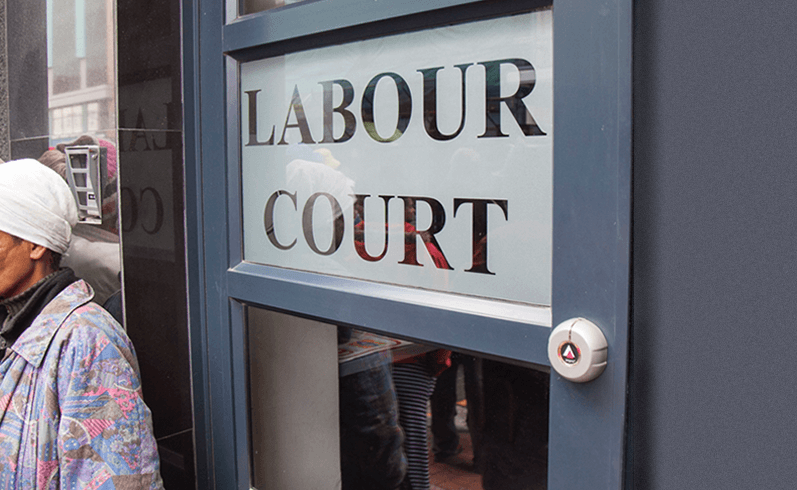
At the Labour Court in Cape Town, Harris, with the help of SACTWU, argued that his dismissal was automatically unfair discrimination based on his religion, belief or conscience.
The employer denied any discrimination, saying Harris was dismissed because he refused to follow a lawful instruction. In his judgment on 13 November 2026, Judge R Lagrange found that the company knew why Harris had asked for leave before his absence.
The judge rejected Meyer’s claim that he did not know the application was for a religious activity, pointing to the information on the leave forms and Jacobs’s intervention. The judgment also dealt with the employer’s argument that Harris had not proven that attending the training was a compulsory part of his faith.
Judge Lagrange referred to the Constitutional Court’s ruling in MEC for Education: KwaZulu-Natal and Others v Pillay, explaining that constitutional protection covers voluntary religious practices as well as those that are required by faith.
The judge stressed that an employer’s responsibility does not end with simply acknowledging an employee’s religious beliefs. Once told about a religious need, the employer must engage with the employee and look for reasonable alternatives.
The judgment noted that Luxxe had not looked into whether another employee could cover Harris’s driving duties while he was away. The company’s claim that February was a busy time was also weakened by evidence showing that its peak production period usually runs from mid-year until December.
Another employee, Tony, had covered Harris’s driving work in the past when he was away. The company also did not dispute evidence that the week of 20 to 24 February 2023 was relatively quiet, with only one delivery.
Judge Lagrange found that the employer had not shown that accommodating Harris’s request would have caused any serious operational problems. The judge also rejected the idea that Harris’s religious training was just a voluntary self-improvement course that did not deserve protection.
Religious beliefs could not be disregarded
The court found that the company treated Harris differently from how it accommodated Muslim employees. While the employer worked with the union to make arrangements for Muslim staff, it refused to look into similar arrangements when Harris asked for time off for his religious observance.
Judge Lagrange said the company’s reliance on gross insubordination could not justify the dismissal, since the instruction itself clashed with Harris’s sincerely held religious convictions and reasonable accommodation was possible.
The judge concluded that the real and direct reason for the dismissal was Harris’s refusal to give up his religious observance when faced with a rigid instruction from his employer. The dismissal was declared automatically unfair under Section 187(1)(f) of the Labour Relations Act 66 of 1995.
The company was ordered to reinstate Harris to his former position, with no loss of pay or benefits, within 15 days of the judgment. There was no order for costs.
Get your news on the go. Click here to follow the Conviction WhatsApp channel.
