


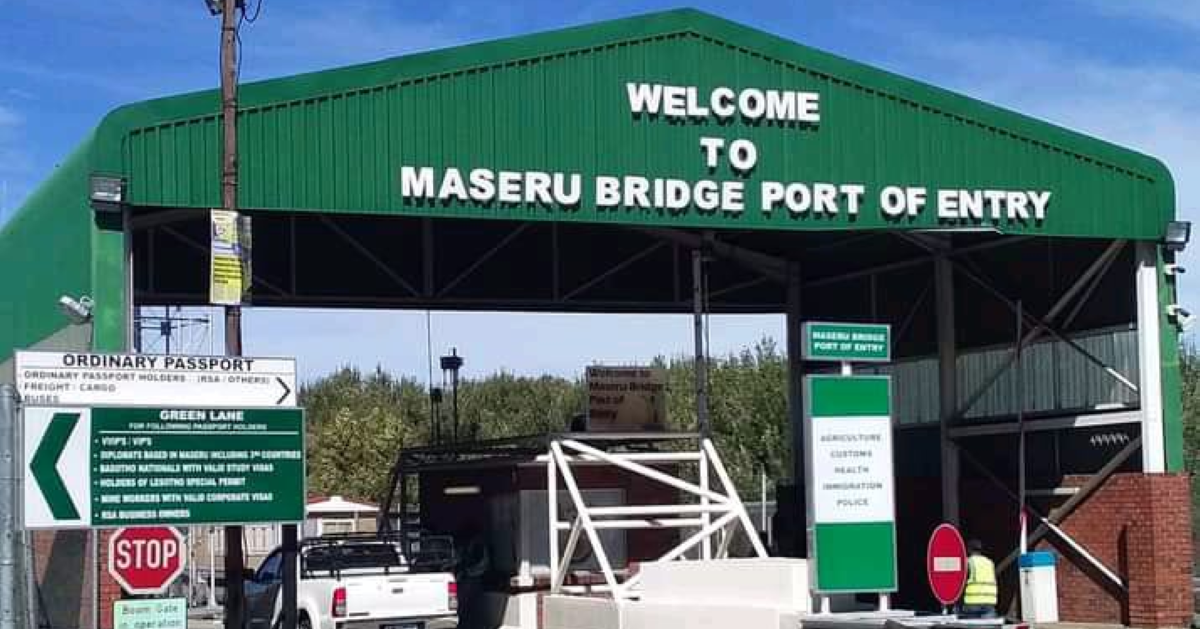
- A SARS customs officer who had worked there since January 2003 was linked to two suspicious export transactions involving the same truck.
- Investigators found that the truck had not passed through the Maseru Border Post and that its consignments never entered Lesotho.
- The Labour Court dismissed his review application, deciding that the commissioner had reasonably concluded his dismissal for dishonesty was fair.
A SARS customs officer with nearly 17 years of service was dismissed after an investigation uncovered two suspicious export transactions involving a truck that had never crossed the border into Lesotho.
Motswetla Edward Lepaku was stationed at the Maseru Border Post in Ladybrand as a Grade 5 customs officer when the transactions occurred during the night shift between 22 and 23 June 2017.
The truck, bearing registration number G3095, was recorded as having been processed for export into Lesotho. However, investigations using Automated Number Plate Recognition cameras and the Vehicle Identification Data System established that the vehicle had last been sighted on the N3 highway in KwaZulu-Natal on 21 June 2017.
The Lesotho Revenue Authority also confirmed that the consignments recorded as having crossed the border had never entered the country. The transactions raised suspicions of a ghost export scheme, in which exporters falsely record goods as having left South Africa to avoid paying value-added tax and facilitate fraudulent VAT refund claims.
Two transactions recorded under the officer’s credentials
According to the investigation, two transactions involving the same truck were processed during the shift. The first was recorded as having arrived at the export gate at 8.28pm on 22 June 2017, with Lepaku’s colleague, T Lethasa, marking it for exit at 8.39pm.
A second transaction was recorded at 10.18pm, with another colleague, S Dimpane, processing the arrival. The truck was subsequently marked for exit at 4.40am on 23 June using Lepaku’s employee credentials. SARS’ investigation established that the truck had never been at the border during either transaction.
Lepaku denied knowingly participating in the scheme and maintained that Dimpane had framed him by using his iPod while he was away from his workstation.
Customs officials were issued with individual iPods linked to their employee identification numbers. However, if a device entered sleep mode, another person could unlock it using a universal PIN without logging out the original user. Any subsequent transaction would then be recorded under the original user’s credentials.
Lepaku testified that Dimpane had visited his cubicle during the night shift and could have used the device while he briefly went to the toilet.
Officer challenges dismissal
Lepaku was suspended in July 2017 and charged with dishonesty for allegedly processing fictitious consignments to enable exporters to claim undue VAT refunds. Following a disciplinary enquiry, he was found guilty of dishonesty. His internal appeal was dismissed on 25 November 2019, resulting in the termination of his employment.
He referred an unfair dismissal dispute to the Commission for Conciliation, Mediation and Arbitration (CCMA). In November 2023, the commissioner found that his dismissal was substantively fair but procedurally unfair because SARS had failed to comply with aspects of its disciplinary procedures.
These included delays in communicating the disciplinary and appeal outcomes, as well as the appointment of a non-manager as initiator. The commissioner ordered SARS to pay Lepaku R6 928.40, equivalent to one week’s remuneration, as compensation for the procedural unfairness.
Dissatisfied with the finding that his dismissal was substantively fair, Lepaku approached the Labour Court seeking to have the award reviewed and set aside. He wanted a finding that his dismissal was unfair and sought reinstatement or alternative compensation.
Judge rejects framing defence
In the Labour Court, Judge R Lagrange found that the commissioner had reasonably evaluated the evidence and rejected Lepaku’s claim that Dimpane had used his credentials. The judge noted that Lepaku had ultimately conceded that the truck never crossed the border, undermining his earlier attempt to argue that the first transaction was legitimate.
Judge Lagrange also found that the workstation login records relied upon by Lepaku only established that Dimpane had accessed a computer in the main office. They did not prove that he had printed the relevant customs documents or used Lepaku’s iPod.
The judge further observed that Dimpane’s alleged involvement in the broader scheme did not automatically absolve Lepaku, as ghost exports required cooperation between arrival and exit officers. Lepaku’s explanation was also weakened by his contradictory evidence about the first transaction involving the truck.
Judge Lagrange held that the possibility that Dimpane had accessed the iPod during Lepaku’s toilet break was not enough to make the commissioner’s finding unreasonable. The judge explained that while such a possibility might have provided an alternative explanation sufficient to raise reasonable doubt in a criminal trial, the labour dispute was decided on a balance of probabilities.
The court concluded that the commissioner had reasonably found Lepaku to be a willing participant in the dishonest scheme rather than an innocent scapegoat.
Get your news on the go. Click here to follow the Conviction WhatsApp channel.
