


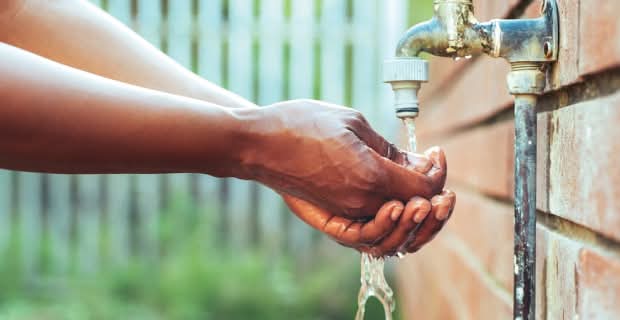
- Corruption and mismanagement fuel shallow water justice across South Africa.
- Temporary fixes like tankers and pit toilets endanger lives and deepen inequality.
- Only long-term investment and accountability can deliver real water justice
Water is essential for survival. Our Constitution recognises this by entrenching the right of access to water in the Bill of Rights. Yet, 30 years after the dawn of our democracy, millions still do not have access to safe, clean and piped water. There are many reasons for this, ranging from poor maintenance to municipal mismanagement. However, a key theme that underpins these factors is corruption.
Money that is supposed to be allocated to maintaining and creating infrastructure and managing systems that are necessary for the effective distribution of water has instead made its way into the pockets of private companies and politicians. The results are startling. In Hammanskraal, for instance, untreated water led to a cholera outbreak that resulted in the deaths of 32 residents and the treatment of acute diarrhoeal infections in hundreds more.
This and many other tragic outcomes clearly show that the cost of poor service maintenance extends beyond financial figures; it is measured in human lives. Waiting for the worst-case scenarios to happen before getting anything done is simply not sustainable. In a country with rainfall that is well below the world average, a focus on capital expenditure and regular maintenance is a key solution for restoring failing infrastructure. However, our government focuses on saving money in the short term, relying on shallow justice, rather than using transformative practices that would effectively save money and lives.
The shallow water justice approach
Shallow water justice does not involve genuine, long-lasting transformation. Instead, it involves the establishment of policies designed to appear, on the surface, to be meeting the government’s constitutional duty.
Shallow justice blends particularly well with systemic corruption, allowing government officials to abuse their power for personal gain. These officials will usually focus on implementing short-term solutions for immediate cost savings. Using the cheapest option available ensures that there is more money available for plundering.
However, as is generally known, the cheapest option is not always necessarily the best. Short-term solutions such as water tankers and portable toilets cannot be depended on indefinitely. Everyone in South Africa deserves infrastructure that is reliable and efficient. For transformative water justice, current policies urgently need revision to focus on long-term solutions.
The basic water allocation
The basic water allocation is a powerful example of shallow water justice. It looks sufficient, but in reality, it is nowhere near that.
The regulatory basic water allocation is 25 litres of water per person per day, provided for free to qualifying households. This translates to 6000 litres of water per household each month.
Daily basic water requirements for a single person include approximately 5 litres for drinking and eating, 5 litres for handwashing, 5-15 litres for washtub bathing (15-25 litres for showering), and 7 litres for flushing a water-saving toilet once. This easily exceeds 25 litres. It also excludes other essential household uses like cleaning surfaces and utensils, preparing food, washing laundry, watering vegetable gardens, and caring for domestic animals.
This limited provision of water means that households are often forced to make sacrifices for the sake of survival. Many of these households do not have the funds to pay for additional water, which means that they have no choice but to make the 25 litres work. For instance, some households may reuse water in various contexts, skip bathing for days, or prioritise drinking water over hygiene. These coping mechanisms may lead to the contraction of diseases and may cause long-term health complications.
Water tankers
The usage of water tankers as a long-term solution for water provision is becoming worrisome. While tankers are vital for areas without water connections, they should not replace permanent water provision systems.
Water tankers come at a huge financial cost. At the beginning of 2025, the City of Johannesburg entered into a questionable R263 million contract for the provision of water tankers for three years.
There are also the costs to residents who rely on tankers. Water refills are not consistent or sufficient, leaving communities without water for days. The locations of communal JoJo tanks frequently force individuals to travel to fetch water. This can be costly for the elderly, working, or infirm who likely have to pay others to fetch water for them.
JoJo tanks also require regular cleaning to avoid health complications. But this does not happen. Without regular maintenance, JoJo tanks allow the growth of algae or risk having animals fall in and die. Mafias around water tankers who receive these water tanker tenders are incentivised to damage water infrastructure to secure longer and more lucrative contracts.
Pit toilets
Water infrastructure to remove and treat sewage is another aspect of effective sanitation. Conventional toilets, despite being a necessary part of this infrastructure, remain inaccessible for many. The result is the usage of pit toilets, which are little more than excrement-filled holes. The government is aware of the importance of replacing pit toilets.
The campaign to remove pit toilets from schools across South Africa only really began after multiple children, including a 3-year-old toddler, died from falling into pit toilets. However, the National Norms and Standards identify the basic acceptable level of toilet sanitation as “at least a Ventilated Improved Pit (VIP) toilet per household for basic sanitation.” The government can replace pit toilets with “Ventilated Improved Pit toilets” before claiming success.
VIP toilets, according to a parliamentary response in 2015, were cheap to construct at R9500. In comparison, conventional toilets were R12000-R15000 without adding the cost of underground water infrastructure.
This conveniently forgets maintenance costs. Additives, emptying with sewage trucks, and the constant education on how to use VIP toilets safely are all regular maintenance costs.
These recurring costs soon overbalance the cost of installing waterborne toilets that need comparatively little maintenance.
Moving to transformative water justice
A common thread between these water injustices is using cheap solutions that are only suitable for the short term. With cheap and temporary solutions, the price increases when one considers the need for maintenance, refilling, cleaning, education, and replacements.
Instead, the government should focus on the long term with capital investment to build effective infrastructure. Effective and consistent maintenance would improve water delivery. Spending more on effective long-term solutions will likely lead to long-term savings in the future.
Continuing government failures also require residents of South Africa to step up and hold the government accountable. To this end, the State Capture and Beyond project developed a report on water justice to help individuals understand their constitutional right to water and to advocate for their rights. If you’d like to learn more about the status of water in South Africa, access the report at https://beyondstatecapture.org.za/water-report/
Conviction.co.za
Get your news on the go. Click here to follow the Conviction WhatsApp channel.
