


- The article argues that the so-called township economy is largely a myth that obscures structural economic exclusion.
- It contends that townships remain spaces of consumption and labour extraction rather than production, ownership and industrial development.
- It further argues that anti-immigrant campaigns and spaza-shop debates do not address the deeper crisis of land, capital, manufacturing and value-chain exclusion.
Every society tells itself comforting stories. In South Africa, one of the most enduring is the notion of the “township economy”. Politicians celebrate it, development agencies fund it, banks market products around it, and consultants produce glossy reports proclaiming its untapped potential.
More recently, anti-immigrant campaigns have recast it as an economic territory that must be reclaimed from foreign nationals. Yet beneath the rhetoric lies an uncomfortable truth: the vaunted township economy does not exist as an economy in any meaningful sense. It is a convenient lexicon that sanitises structural abandonment and disguises the persistence of apartheid’s economic geography.
For more than three decades, South Africa has congratulated itself on extending democracy while avoiding a far more difficult conversation about political economy. We have become adept at measuring inclusion through shopping centres, bank branches and retail activity rather than through ownership of productive assets, industrial capacity or participation in value chains.
The township economy narrative reinforces this illusion by suggesting that townships are simply underdeveloped markets awaiting entrepreneurial activation. They are not. They remain spatial expressions of an economic order designed to extract labour rather than create prosperity.
Yet this structural critique risks overlooking the agency of township residents themselves. As David Dickinson demonstrates in South Africa’s Constitution and the Law of the Township, residents are far from passive victims of structural abandonment. They actively seize menyetla (opportunities), often illicit, to gain advantage in circumstances where lawful avenues have shrivelled.
The tragedy is that these individually rational acts, pursued at scale, undermine collective provision and accelerate the very disintegration that residents seek to escape. Understanding the township requires grasping both the structures that constrain and the agency that, however destructively, reshapes social order from below.
Townships were never meant to prosper
After all, the township was never conceived as an economic unit capable of generating prosperity. It was designed as an instrument of apartheid’s labour system: a place to house Black South Africans cheaply while supplying labour to mines, factories, farms and affluent suburbs. Production occurred elsewhere. Capital accumulated elsewhere. Ownership resided elsewhere.
The township’s purpose was not development but extraction. Democracy supposedly dismantled apartheid’s legal foundations, but in truth left much of its economic geography intact. The result is that millions still inhabit spaces built for exclusion rather than opportunity.
Describing these spaces as possessing a “township economy” gives them an economic legitimacy they have never possessed. An economy implies productive capacity, investment, innovation, value addition and the ability to generate wealth from within.
Most townships exhibit the opposite characteristics. They consume what others produce. Their residents overwhelmingly participate at the lowest end of value chains, as consumers, informal traders, service providers or wage earners whose incomes originate elsewhere. Money enters the township only briefly before flowing back into corporate South Africa through supermarkets, banks, insurers, transport operators and multinational consumer brands.
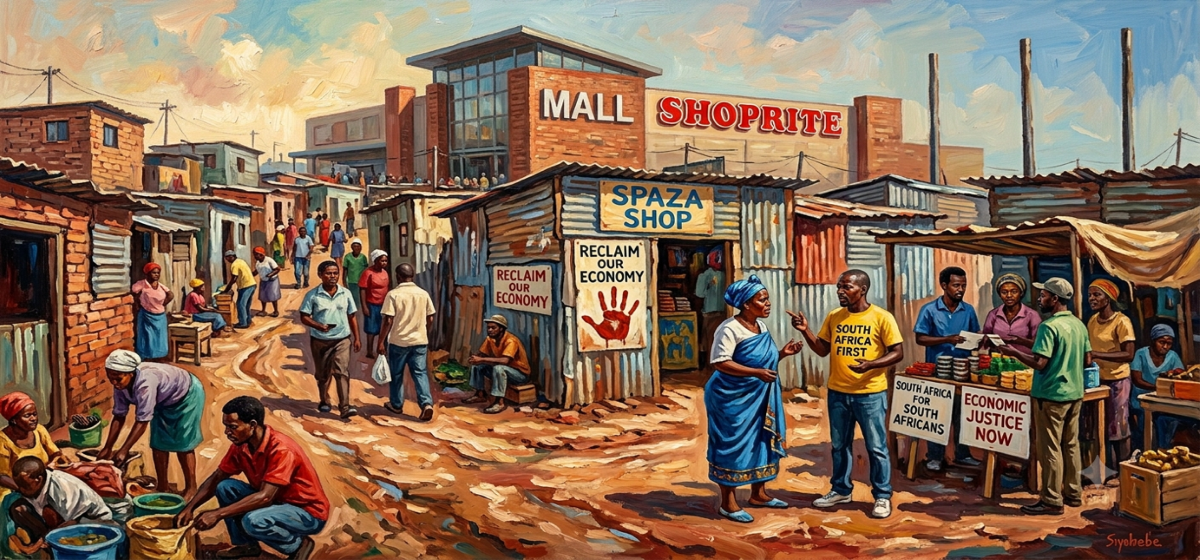
This is why the sprawling shopping malls that dominate township skylines should not be mistaken for development. They are monuments to consumption rather than production. Their presence demonstrates the extraordinary efficiency with which corporate South Africa has learned to extract purchasing power from poor communities without embedding manufacturing, industrial capability or meaningful ownership there.
The familiar red Shoprite signage, gleaming bank branches and ubiquitous alcohol advertisements are often celebrated as signs of inclusion. In reality, they are signposts marking an economic battle zone and chaos, reminiscent of Palestine or Haiti, where wealth enters only to leave almost immediately.
The language of entrepreneurship obscures this reality. Spaza shops, car washes, street vendors and backyard mechanics undoubtedly demonstrate remarkable resilience and ingenuity. Yet resilience is not development, and survival is not structural transformation. A society cannot confuse economic coping mechanisms with economic emancipation.
When households survive by selling imported goods, recycled products or low-margin services, they remain excluded from ownership of productive assets and from participation in higher-value production networks. The township therefore remains an endpoint for retail rather than a starting point for industrialisation.
This is where the popular discourse about the township economy becomes dangerous. It romanticises conditions that should provoke national shame. Instead of asking why millions remain trapped in areas with almost no productive infrastructure, we celebrate their capacity to survive within those constraints.
Poverty becomes entrepreneurial spirit. Structural exclusion becomes innovation. Informality becomes empowerment. The result is a vocabulary that normalises economic failure while disguising it as grassroots success. South Africa congratulates itself on managing deprivation rather than eliminating it.
The Republic ends at the township boundary
The problem extends far beyond economics. The township increasingly functions under a normative order distinct from the constitutional order imagined in 1994. Dickinson describes this informal order as the lex lokasi, or the law of the township, which governs much of everyday life where formal institutions either fail to function or appear only intermittently.
Crucially, lex lokasi is not just an absence of law but an emergent social order: a “multidimensional spectrum of power resources” residents deploy opportunistically. It arises from agency, drawing on cultural norms, community networks and sometimes force when the constitutional order cannot reach them. But it also emerges when individuals pursue advantage without regard for collective consequence.
Residents negotiate disputes through local networks, regulate informal commerce through community arrangements and develop their own systems of authority where the state’s presence is weak or inconsistent. Constitutional law exists formally, but lived reality is often governed by something else.
Municipal by-laws provide a clear illustration. Their application is inconsistent, selective and often negotiated rather than systematically enforced. Informal electricity connections, unlicensed businesses, backyard rentals, informal transport arrangements and street trading often operate outside formal regulation because there is little alternative.
Elections, municipal accounts, electricity billing and occasional policing remind residents that the constitutional state exists. Yet between these episodic encounters, everyday governance frequently rests on negotiated local norms rather than consistent public authority. Constitutional South Africa governs intermittently; the lex lokasi governs continuously.
This fractured reality reflects something deeper than administrative incapacity. Boaventura de Sousa Santos describes modern societies as divided by an abyssal line. Frantz Fanon recognised similar divisions in colonial societies, where this divide separates the “zone of being”, where rights are meaningfully protected, from the “zone of non-being”, where legal guarantees become largely symbolic.
Contemporary South African townships increasingly resemble this zone of non-being. Their residents possess constitutional rights in theory but experience them unevenly in practice. The Constitution reaches these communities often enough to demand compliance, but rarely enough to secure dignity, equality or meaningful economic citizenship. This resonates with the broader critique that South Africa’s celebrated constitutional order coexists with enduring structural injustice and uneven realisation of rights.
This understanding also challenges conventional interpretations of service-delivery protests. They are often portrayed as democratic citizens petitioning the state for better services. That interpretation is incomplete. Communities beyond the abyssal line are visible to the formal state primarily when they become disruptive. Burning tyres, blocked roads and damaged infrastructure interrupt the normal functioning of constitutional South Africa.
The protests are therefore not simple requests for improved services but eruptions from communities whose ordinary existence has become politically invisible. The township becomes audible only when it becomes inconvenient.
Abahambe cannot fix structural abandonment
The recent Abahambe mobilisation reflects precisely this deeper crisis. Public debate has focused on foreign-owned spaza shops, suggesting that reclaiming township commerce for South Africans will somehow restore economic justice. This diagnosis mistakes symptoms for causes.
Replacing Somali, Ethiopian, Bangladeshi or Pakistani shopkeepers with South African shopkeepers does not alter ownership of land, capital, logistics, finance or manufacturing. It changes the retailer’s identity without altering the structure of the economy. Ownership of the till is mistaken for ownership of production.
The conflict itself should also be understood differently. It is not fundamentally a contest between South Africans and foreign nationals but the meeting point of two failed post-colonial political economies. In their excitement, both Nigeria and Ghana fail to admit that they have dismally failed to transform colonial economies, leaving their populations to compete over shrinking opportunities in spaces abroad.
Migrants arrive from states unable to provide livelihoods for their citizens, hoping to find opportunity beneath the lights of Johannesburg, Pretoria or Durban. Instead, they encounter millions of Black South Africans who have themselves been excluded from meaningful economic participation.
Both groups occupy the same geography of abandonment and compete for survival within spaces designed historically to serve others. This explains why debates around foreign-owned spaza shops rarely address the larger political economy.
South Africa needs factories, not more spaza shops
The township remains overwhelmingly disconnected from productive value chains. Its people consume food they do not produce, purchase goods they do not manufacture and rely on financial institutions they do not own. Wealth continues to accumulate elsewhere.
What appears to be a local economy is, in fact, an elaborate system for transferring purchasing power from historically excluded communities to established centres of capital accumulation. That system remains remarkably consistent with the spatial logic inherited from apartheid.
South Africa therefore faces a choice. It can continue celebrating the myth of the township economy while congratulating itself on incremental improvements in retail access and informal entrepreneurship. Or it can confront the uncomfortable reality that genuine transformation requires productive investment, industrial development, technological capability, community ownership and participation in national and global value chains.
Until that happens, the township will remain less an economy than a marketplace servicing an economy located elsewhere. The real question, then, is not who owns the spaza shop. It is why, after more than three decades of constitutional democracy, the township still lacks the productive foundations that define a genuine economy.
Until South Africa answers that question honestly, the language of the “township economy” will remain a dangerous myth: one that disguises organised economic neglect as resilience, mistakes survival for transformation and encourages the nation to celebrate adaptation to injustice instead of demanding its end.
Siya yi banga le economy!
Get your news on the go. Click here to follow the Conviction WhatsApp channel.
The opinions expressed in this article are solely those of the author and do not necessarily reflect the views of Conviction.co.za
