


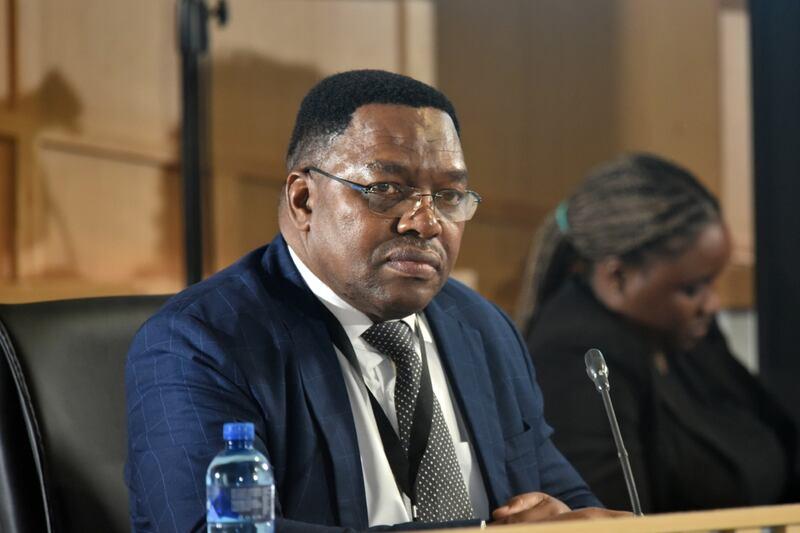
- The Masemola debacle highlights the difficult position of public servants caught between political directives and their constitutional responsibilities.
- Political patronage and fear of career retaliation can discourage critical thinking and independent decision-making within public institutions.
- South Africa needs stronger institutions that protect professional independence and place constitutional obligations above political proximity.
The ongoing parliamentary spectacle surrounding suspended National Police Commissioner General Fannie Masemola brings into sharp, unforgiving focus a fundamental flaw at the heart of South Africa’s criminal justice administration.
The ANC has proposed that Parliament’s ad hoc committee make an adverse finding against Masemola. Its grievance? That he failed to “resist” an allegedly unlawful directive issued by suspended Police Minister Senzo Mchunu regarding Crime Intelligence positions and the PKTT.
In doing so, Parliament is attempting to enforce a textbook version of administrative accountability while wilfully ignoring the systemic, cut-throat reality that can make such accountability virtually impossible.
I am not a politician. I am a criminalist and a researcher who observes the architecture of our state through an objective lens. Yet, with the limited knowledge and experience I have gathered over the years, I am constantly reminded of a brutal truth: politics is not for the faint-hearted.
The current parliamentary processes point to a grim, Machiavellian reality. Our democratic landscape has evolved into an arena where “survival of the fittest” appears to be the ultimate game plan, not only for career politicians but also for professionals leading critical administrative departments.
Today, we are confronted with the uncomfortable reality that accountability in South Africa may fall not on those who issue compromised instructions, but on those who comply because they fear the consequences for their careers.
The cost of trading wisdom for might
When analysing this structural trap and the cost of survival within state structures, the words of the prologue echo with haunting accuracy. In our current governance framework, the exchange of wisdom for political might manifests as a patronage culture that demands the erosion of ethical clarity.
Accepting unlawful or highly compromised directives without questioning the status quo can bring immediate, temporary rewards. It can secure rapid promotions, lucrative tenures and political stability. But these rewards are a dangerous mirage. They come at a devastating cost to the nation because the moment political self-preservation takes over, the interests and safety of ordinary citizens take a back seat.
Now we are witnessing the inevitable endgame of this dynamic. Those who toe the line simply to survive may eventually discover that they have signed their own professional death warrants. They can become the ultimate sacrificial lambs when the political going gets tough.
When Masemola testified before Parliament’s ad hoc committee, he stated with sobering candour that defying a sitting Police Minister’s directive would have been “career-limiting”. To any pragmatic observer of South African governance, this is not merely a convenient excuse; it reflects the structural pressures facing officials who challenge political authority.
Within state departments, the moment an official demonstrates critical thinking, asks difficult questions or displays an independent mind, the machinery of political retaliation can be quietly activated. Career advancement can be blocked, officials can be isolated, and their reputations can be damaged. Conversely, those who choose to go with the flow may simply postpone the consequences. They can ultimately be sacrificed on the altar of silence, discarded as pawns by the very kingmakers who demanded their compliance in the first place.
Is South Africa ready for critical thinkers?
This systemic crisis leaves us with an uncomfortable question: Is South Africa truly ready for critical thinkers? If we were to look across our fractured society and speak to the thousands of highly qualified professionals who are unemployed, including those whose dignity has been dragged through disciplinary proceedings in what they regard as attempts to silence them, what story would they tell? If we asked them what happened, many would describe a similar experience.
Their alleged offence was not incompetence or corruption. Rather, they believe they were punished for using their intellect and ethical judgement in an attempt to serve the people of South Africa. For refusing to bend the knee to patronage and for choosing the law over the lawmaker, they say they were cast out, blocked and economically broken.
Tragically, our young people are watching this play out in real time. They are being exposed to a culture that encourages shortcuts. Our youth are quickly learning the cynical lesson that, in contemporary South Africa, it is not what you know but who you know that matters.
Young minds are being taught by example to avoid accountability, to blame others and to do whatever it takes to survive changing political circumstances. We risk raising a generation on the premise that independent intellect is a liability and blind compliance is an asset.
Institutional deficits and the collapse of oversight
This structural decay does not happen in a vacuum. It contributes to the instability we see in our national security apparatus. Recently, Professor Somadoda Fikeni highlighted what he described as the profound systemic decline of our democratic dispensation, tracing how meritocracy has been weakened in favour of factional loyalty.
This institutional paralysis was further highlighted by Dr Mark Shaw, whose extensive research on criminality has documented structural weaknesses within the SAPS and its difficulties in responding adequately to organised crime. These challenges are compounded by divisions within its leadership and the broader political environment.
How can we build an elite, professionalised public institution that is responsive to the needs of our people when operational commands can be shifted like pieces on a political chessboard to satisfy the immediate interests of political kingmakers?
When an administrative head is forced to prioritise political alignment over institutional continuity, the entire police service risks losing its moral compass and operational direction. The same pattern may be evident elsewhere in the public service, including within institutions of learning.
A public entity that is constantly looking over its shoulder to gauge the shifting winds of its political masters cannot effectively confront sophisticated transnational syndicates ravaging our communities.
Turning the tide: A nation of independent minds
If this country is ever to overcome the paralysis caused by political patronage within institutions of learning, the SAPS and the wider public service, we must fundamentally change our relationship with power. We must foster a generation of critical thinkers who understand that true patriotism means respecting those in authority without surrendering their principles to political power.
Only when public servants value the Constitution more than their proximity to power will there be real, tangible hope for South Africa. There you are, South Africa. Look at the state of our leadership and the lessons we are teaching the next generation. Be the judge.
Get your news on the go. Click here to follow the Conviction WhatsApp channel.
The opinions expressed in this article are solely those of the author and do not necessarily reflect the views of Conviction.co.za or Unisa.
