
Skip to content
Close Menu
ConvictionConviction
  • Home
  • Law & Justice
  • Special Reports
  • Opinion
  • Ask The Expert
  • Get In Touch

Subscribe to Updates

Get the latest creative news from FooBar about art, design and business.

What's Hot

A Pan Afrikan intellectual reflects on June 16, Africa’s youth and the future of education

June 16, 2026

From Soweto to 2076 — 50 years of reckoning, and 50 more of possibility

June 16, 2026

Defending our democracy against misinformation and disinformation in South Africa

June 15, 2026
Facebook X (Twitter) Instagram
Trending
  • A Pan Afrikan intellectual reflects on June 16, Africa’s youth and the future of education
  • From Soweto to 2076 — 50 years of reckoning, and 50 more of possibility
  • Defending our democracy against misinformation and disinformation in South Africa
  • Mothers considering adoption have rights to privacy, dignity and legal support
  • Father gets suspended jail sentence for prioritising business interests over maintenance
  • Ekurhuleni faces looming deadline to rebuild homes at N12 settlement
  • Homeowner’s challenge to FSCA decision fails as tribunal finds no direct benefit for him
  • Municipality worker says he was underpaid for three years, wins right to pursue claim
Facebook X (Twitter) Instagram
ConvictionConviction
Sonneblom
  • Home
  • Law & Justice
  • Special Reports
  • Opinion
  • Ask The Expert
  • Get In Touch
ConvictionConviction
Home » New book shows how Bayesian machine learning is reshaping finance
Special Reports

New book shows how Bayesian machine learning is reshaping finance

Bayesian Machine Learning in Quantitative Finance explains why models that measure uncertainty are becoming vital in banking, insurance, and investment.
Conviction Staff ReporterBy Conviction Staff ReporterApril 26, 2026No Comments
Facebook Twitter Pinterest LinkedIn WhatsApp Reddit Tumblr Email
Dr Wilson Tsakane Mongwe says Bayesian Machine Learning in Quantitative Finance was written to help banks, insurers and investors move beyond single-number predictions and make decisions with a clearer understanding of uncertainty. Picture: Supplied
Share
Facebook Twitter LinkedIn Pinterest Email
  • A new book shows how Bayesian machine learning can be applied to real financial decisions in banking, insurance, and investment.
  • Mongwe and his co-authors question models that provide single answers without addressing uncertainty.
  • The work emphasises transparency and measurable confidence as key aspects of modern financial systems.

Financial institutions make high-stakes decisions daily, often using models that present a single answer without indicating its reliability. The gap between output and confidence is what Bayesian Machine Learning in Quantitative Finance aims to address directly.

Written by Wilson Dr Tsakane Mongwe, Rendani Mbuvha, and Tshilidzi Marwala, the book reflects a practical frustration within the financial sector.

Mongwe shares, “After it came out, we kept getting the same question from colleagues working in banks and insurers, who said, ‘This is interesting, but how do I actually use it in my job?’”

That question arose following their earlier book, Hamiltonian Monte Carlo Methods in Machine Learning, and became the foundation for this new work. He adds, “We wanted to take these methods out of research papers and demonstrate how they apply to everyday problems in finance, such as pricing insurance, making lending decisions, and managing investments.”

From Tzaneen to quantitative finance

Mongwe’s perspective on the subject combines technical depth with personal experience. Born in Tembisa and raised in Tzaneen by his grandmother, he finished his schooling in Limpopo before studying actuarial science at the University of Cape Town.

He earned a master’s degree in Mathematical Finance and later obtained a computer science qualification from the University of South Africa. Eventually, he completed a PhD in Artificial Intelligence at the University of Johannesburg, under Marwala's supervision.

He describes his attraction to the field plainly: “I enjoy mathematics, and in finance, the mathematics has real effects on people’s savings, their insurance premiums, and their access to credit.”

Why one number hides more than it reveals

A main argument in the book is that traditional financial models create a false sense of certainty. They offer a single estimate and treat it as the answer, even when the answer may come from weak or incomplete information.

Mongwe notes, “If I ask a regular financial model what a share will be worth next month, it gives me one number, say R120. That is useful, but it hides a lot. It does not tell me whether R120 is a strong estimate or a rough guess.”

The book introduces a probabilistic framework. Instead of one number, models provide a range of outcomes along with a measure of confidence.

He explains, “A Bayesian model offers a range instead. It still gives you the most likely value, but it also shows how wide the range of possibilities is and how confident the model really is.”

He adds, “It’s the difference between someone saying it will rain tomorrow and someone saying there’s a 70 percent chance of rain. You behave differently depending on which one you hear.”

What this looks like in practice

The book’s strength lies in how it translates these concepts into real financial settings. One of the clearest examples is in insurance pricing, especially when data is limited.

Mongwe explains that traditional models perform well with large data sets, such as in major cities, but struggle in smaller or rural areas. In those cases, models may still deliver precise outputs without recognising their own uncertainty.

He elaborates, “A Bayesian model is more honest. It will still give you a premium, but it indicates when the estimate relies on limited information.”

He describes the consequences: “When an insurer prices a policy without realising how little it knows, it can make costly mistakes. It might price too high and lose customers or too low and take on more risk than expected.”

Transparency is becoming unavoidable

The book consistently returns to the issue of explainability. Financial models do not work alone. Their outputs impact real people and must be justified.

Mongwe states, “If a model denies your loan or sets your insurance premium, someone has to explain why, to you, to a regulator, to the board.”

He points out that black-box systems have difficulty in this context because explanations may be absent or only created after the fact.

Mongwe explains, “What is pushing everyone in this direction is not necessarily the technology. It is mainly the regulators. They are asking tougher questions about how models are built, when they fail, and what the institution does to verify them.”

He adds that some institutions are already adapting while others continue to use models that overlook uncertainty.

Mongwe says, “Our data is often patchy. The methods that properly quantify uncertainty are especially useful in these situations.”

He notes that South Africa has a chance to adopt these approaches earlier, as it is less constrained by outdated systems.

Opening the door for others

Mongwe concludes, “I did not know any actuaries growing up. I did not know anyone who worked in a bank. Mathematics opened the door, and the scholarship guided me through it.”
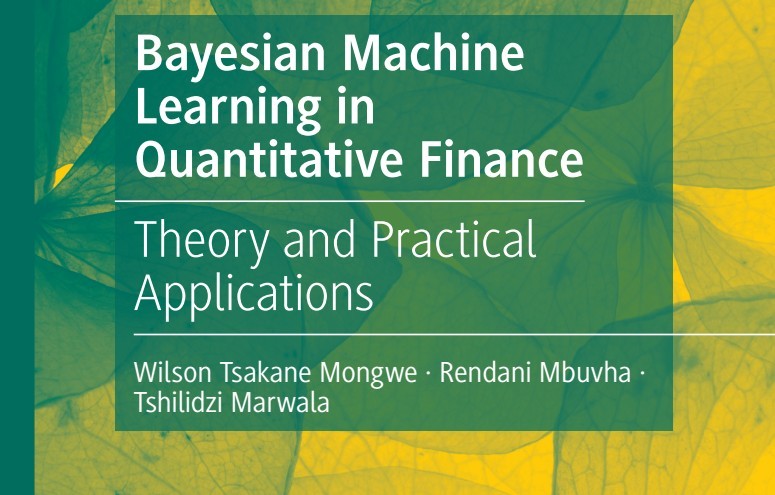
BUY THE BOOK HERE

Conviction.co.za

Get your news on the go. Click here to follow the Conviction WhatsApp channel.

Artificial Intelligence Bayesian machine learning Dr Wilson Tsakane Mongwe financial risk modelling quantitative finance
Share. Facebook Twitter Pinterest LinkedIn Tumblr Telegram Email
Conviction Staff Reporter

Conviction.co.za — Towards a Positive Impact on People

Related Posts

From newsroom deadlines to the Bar, Rorisang Kgosana pursues a higher calling

June 13, 2026

Batohi cannot meddle with enquiry procedures after abandoning testimony, panel rules

June 12, 2026

Legal practitioners and law firms invited to reach 100 000 monthly readers

June 6, 2026
Leave A Reply Cancel Reply

Prove your humanity: 10   +   10   =  

Subscribe to our newsletter:
Top Posts

Making sectional title rules that work: A practical guide

January 17, 2025

Protection order among the consequences of trespassing in an ‘Exclusive Use Area’

December 31, 2024

Between a rock and a foul-smelling place

November 27, 2024

Irregular levy increases, mismanagement, and legal threats in a sectional title scheme

June 2, 2025
Don't Miss
Opinion
5 Mins Read

A Pan Afrikan intellectual reflects on June 16, Africa’s youth and the future of education

By Ras Advocate Sipho MantulaJune 16, 20265 Mins Read

Ras Adv Sipho Mantula reflects on June 16, the Day of the African Child and the urgent need for African-centred education.

From Soweto to 2076 — 50 years of reckoning, and 50 more of possibility

June 16, 2026

Defending our democracy against misinformation and disinformation in South Africa

June 15, 2026

Mothers considering adoption have rights to privacy, dignity and legal support

June 15, 2026
Stay In Touch
  • Facebook
  • Twitter
  • WhatsApp
Demo
About Us
About Us

Helping South Africans to navigate the legal landscape; providing accessible legal information; and giving a voice to those seeking justice.

Facebook X (Twitter) YouTube WhatsApp Twitch RSS
Latest posts

Making sectional title rules that work: A practical guide

January 17, 2025

Protection order among the consequences of trespassing in an ‘Exclusive Use Area’

December 31, 2024

Between a rock and a foul-smelling place

November 27, 2024
OUR PICKS

Standard Bank should have investigated mental health concerns before dismissal, CCMA finds

June 10, 2026

Agricultural advisors declared scientists in landmark Labour Court ruling

February 17, 2026

Law enforcement officer keeps job after City of Cape Town fails in cannabis dismissal appeal

June 10, 2026
© 2026 Conviction.
  • Home
  • Law & Justice
  • Special Reports
  • Opinion
  • Ask The Expert
  • Get In Touch

Type above and press Enter to search. Press Esc to cancel.

Powered by
►
Necessary cookies enable essential site features like secure log-ins and consent preference adjustments. They do not store personal data.
None
►
Functional cookies support features like content sharing on social media, collecting feedback, and enabling third-party tools.
None
►
Analytical cookies track visitor interactions, providing insights on metrics like visitor count, bounce rate, and traffic sources.
None
►
Advertisement cookies deliver personalized ads based on your previous visits and analyze the effectiveness of ad campaigns.
None
►
Unclassified cookies are cookies that we are in the process of classifying, together with the providers of individual cookies.
None
Powered by