


- New archival research challenges accepted casualty figures and long-standing narratives.
- Geelbooi Mofokeng’s role remains disputed amid conflicting records and testimony.
- The case highlights the need to reconcile oral history with archival evidence.
This year marks 66 years since the Sharpeville Massacre. Since 1994, more often than not, some new kind of commission of inquiry is established to respond to a major crisis faced by the government. The commissions are often framed as moments of reckoning — institutional spaces where ‘truth’ is meant to lead to ‘justice’ and accountability.
In 1960, the apartheid government set up the Wessels Commission of Inquiry “to investigate and report on the occurrences in the Districts of Vereeniging, namely at Sharpeville Location, Evaton and Vanderbijlpark, province of the Transvaal, on 21 March 1960.”
People who visit this township, which includes some sites that are on the list of UNESCO World Heritage, do so without connecting the dots with respect to the names on the headstones at the burial grounds, the white pillars in the garden of remembrance, and those etched on four plaques fixed to the front wall of the gatehouse of the Human Rights Precinct.
In the early morning of 21 March 1960, the Pan Africanist Congress (PAC) led anti-pass laws demonstrations in many parts of South Africa. In Sharpeville, protestors gathered at the police station demanding court arrests for not having Passbooks with them.
Almost all available literature provides consistent accounts of what led to the massacre on that day. In 2024, Nancy Clark and William Worger, research fellows at the University of the Free State, conducted research at the National Archives of South Africa and overturned the established grand narrative in terms of its cause and casualties, as well as often unquestioned police accounts and views on the Sharpeville Massacre.
Medical and compensation claim records in the national archives provide conclusive proof that the number of victims, at least 91 killed and 238 wounded, was far higher than the canonical figures of 69 dead and roughly 180 wounded as previously thought.
The Geelbooi Mofokeng controversy
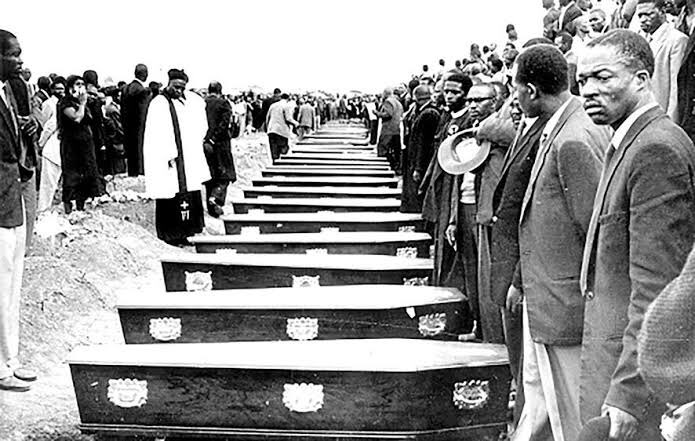
The first mass funeral of 63 victims was held on 30 March 1960. The remaining six of the 69 were buried on 4 April 1960, a few metres away from the other graves. One of the most particularly interesting and entirely overlooked names of the Sharpeville Uprising is that of Geelbooi Mofokeng, who is considered the catalyst to the shooting. What is striking about this name is that there is no headstone bearing his name at the Phelindaba cemetery. His name at this cemetery is replaced by Swaartbooi Mosia.
Geelbooi Mofokeng’s name does, however, appear in one of the plaques mentioned earlier among those who died and not Swartbooi Mosia. Geelbooi Mofokeng, who participated in the demonstration and was reported dead during the shooting, only to “resurrect” and testify months later at the Wessels Commission, is reflected in the archives of the commission, which are in the custody of the National Archives of South Africa.
Philip Frankel, former political studies professor at the University of the Witwatersrand, claimed that he had learned about the identity of Geelbooi Mofokeng from his police informants. The police informant told Frankel that, in December 1959, municipal police found an arms cache hidden in a house in which they were conducting a liquor raid.
They arrested Geelbooi Mofokeng, a self-styled buccaneer and well-known petty offender whom they encountered near the raid scene. The interrogation was carried out by Sergeant Du Bruyn, a special branch operative from the Free State. He was visiting relatives in Vereeniging to commemorate the Day of the Vow on December 16. He was called to assist with the interrogation while he was having evening braaivleis around 1 am.
He came with the bottle of brandy from the evening barbecue and shared it among the white policemen at the station. During drinking, they interrogated Geelbooi, suspended him on a pole, spinning him around between the blows, repeatedly kicked him and beat him with a sjambok. After this severe beating, the police discovered that he knew nothing about the cache, and as the last parting gesture, Sergeant Du Bruyn took an empty brandy bottle he brought and broke it across the back of his neck. He was then thrown, bruised and bleeding, out of the main entrance of the police station. He stumbled away through the dark, deserted streets after he was released.
A few months later, on Monday, 21 March, Geelbooi, last seen dropped by the police after the interrogation, made an appearance at the police station on Monday, along with his fellow petty criminals, after a weekend on a drinking spree. At the police station, he was near the fence at the west gate, where he recognised Sergeant de Bruyn among other white policemen. He apparently shouted “Ek sal die vark skiet” and pulled out a small calibre pistol. A scuffle ensued as his friends tried to stop him from shooting.
He, however, discharged two bullets harmlessly in the air, thereby precipitating the police firing in response. Literature, without mentioning or referring to the actions of Geelbooi, states that “The local detachment of white police panicked and fired into the crowd. The largely undisciplined police force inside the fenced station premises felt threatened in view of the swelling mass of noisy demonstrators and panicked. The police force of 75 was greatly outnumbered and panicky.”
Interestingly, after reading Frankel’s book, the leading South African journalist, Patrick Lawrence, believed that the account of Geelbooi and his actions provided a convincing explanation for what had always been unexplained as the reason why police opened fire on the protestors. Our own enquiry on the death of Geelbooi Mofokeng at the Police archives in Pretoria provided conclusive evidence that the account of his actions is a fallacy. He is not on the police list of deceased people. He, however, appears on the list of the people who were admitted to the Baragwanath hospital for gunshot wounds.
During the proceedings of the commission, without mentioning him by name, Lieutenant Colonel G D Pienaar stated in his evidence that he was the cause of the killing of Sharpeville residents. However, in his evidence during the Wessels Commission’s setting, Geelbooi mentioned that he was a 24-year male staying in Sharpeville, Vuka section S 194 Machobane Street, employed by Vereeniging Consolidated Milling at the time of the Sharpeville uprising.
He arrived in Sharpeville two years before the massacre from Top Location in Vereeniging. On that day, he came to the police station to listen to the message and address to the Sharpeville residents from a high ranking government official regarding the Pass Laws. He also mentioned that he lost his cap during the march, and when he tried to pick it up, that is when the police fired shots.
Geelbooi Mofokeng participated in the demonstration and was reported dead during the shooting, only to testify months later at the Wessels Commission, which was set to investigate the shooting, as reflected in the archives of the commission. The story is compounded by the burial site where his name is on the list of those commemorated, but his grave is missing.
His story is one of those which require further investigation and can shed more light on the Sharpeville Massacre. Such a contradiction is a testament that the history of Sharpeville must be rewritten with the convergence of oral history and archival records. The falsified list was used by the police to use Geelbooi as a scapegoat for the shooting.
Rewriting Sharpeville history
The contradictions surrounding Geelbooi Mofokeng are not minor discrepancies but foundational fractures in the historical record. They expose how official narratives can be shaped, manipulated, or left unchallenged for decades. The case underscores the urgent need for a more rigorous engagement between oral testimony, archival material, and historical interpretation.
Without this convergence, incomplete or misleading accounts risk becoming institutionalised as fact. Ultimately, contested narratives on Geelbooi Mofokeng and the Sharpeville Massacre of 21 March 1960 demonstrate that history is not static. It is continuously revised, questioned, and deepened as new evidence emerges and previously silenced voices are brought into the record.\
Get your news on the go. Click here to follow the Conviction WhatsApp channel.
