


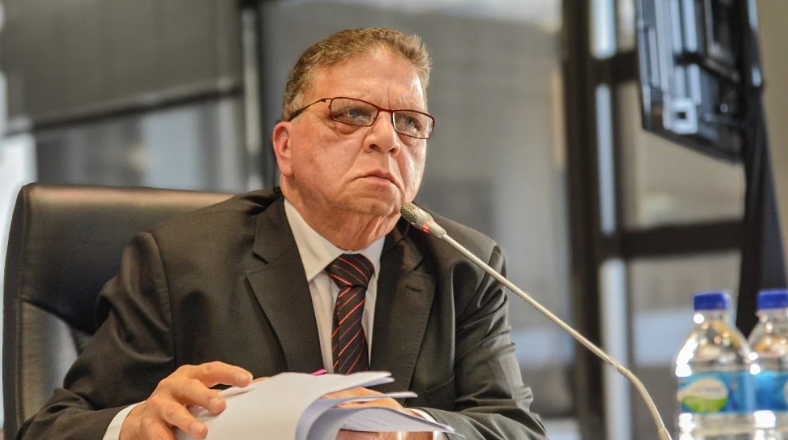
- The Judicial Service Commission has found Judge Mushtak Parker guilty of gross misconduct and recommended his removal from office.
- The findings relate to deliberate dishonesty over contradictory versions of a chambers incident and the non-disclosure of misappropriated trust funds.
- Despite submissions on ill health and mitigation, the Commission held that the conduct was intentional and incompatible with judicial office.
The Judicial Service Commission (JSC) has recommended the removal of Western Cape High Court Judge Mushtak Parker after finding that he engaged in deliberate dishonesty and serious ethical misconduct that strikes at the core of judicial integrity.
The decision was taken at a meeting of the JSC on 13 October 2025 and formally announced in a statement issued on 8 January 2026.
The JSC confirmed that it had considered the report of a Judicial Conduct Tribunal, the full record and transcript of proceedings, and written submissions made by Judge Parker. It concluded that “the conduct of Judge Parker constitutes gross misconduct” and resolved to recommend to the Speaker of the National Assembly that removal proceedings be initiated under Section 177(1)(a) of the Constitution.
The complaints against Judge Parker were lodged by 10 judges of the Western Cape Division of the High Court and separately by the Cape Bar Council. Both complaints were investigated by a Tribunal appointed by the Chief Justice in terms of the Judicial Service Commission Act.
Dishonesty over chambers incident with Judge Hlophe
The first and most serious finding against Judge Parker concerns an incident that took place in his chambers on 25 February 2019 involving then Judge President John Hlophe. The Tribunal found that Judge Parker gave two versions of what occurred during that encounter and that those versions were “contradictory and mutually exclusive”.
The Tribunal held that the versions could not both be true and that “regardless of which version is true, one of them had to be a lie”. It found that by advancing mutually exclusive accounts of the same incident, Judge Parker acted dishonestly. The Tribunal described this conduct as “incompatible and unbecoming of the holding of judicial office”.
The JSC endorsed this finding in full. It recorded that Judge Parker did not dispute that he had provided two contradictory versions and rejected his explanation that the inconsistencies were the result of an honest mistake. The JSC found that “his conduct in doing so was deliberate and amounts to gross misconduct”.
This finding is significant because it does not indicate which version of the incident is correct. It turns on the fact that a judge knowingly placed incompatible versions before accountability structures, undermining the requirement of absolute candour expected of members of the judiciary.
Misappropriation of trust funds and failure to disclose
The second finding relates to Judge Parker’s conduct while practising as an attorney before his appointment to the bench. The Tribunal found that Judge Parker and his partners had misappropriated funds belonging to trust creditors and had acted in breach of the rules of the law society by failing, over a long period, to disclose trust account deficits.
The Tribunal further found that Judge Parker failed to disclose this information when applying for judicial office. During his nomination process and interview before the Judicial Service Commission, Judge Parker stated that there were “no circumstances, financial or otherwise, known to him which might cause embarrassment in undertaking the office of a Judge”.
The Tribunal found this statement to be false. It held that “the trust deficit in his firm was at that time a live financial circumstance that he should have disclosed”. The JSC agreed and went further, finding that the evidence showed Judge Parker was aware of the trust account deficit while he was still an acting judge.
The JSC concluded that Judge Parker’s failure to disclose this information in his nomination questionnaire and during his interview before the JSC was intentional and materially misleading. It found that this non-disclosure, viewed independently of the misappropriation itself, “constitutes gross misconduct on his part”.
Ill health and mitigation rejected
In written submissions to the JSC, Judge Parker relied on mitigation. He submitted that he had cooperated fully with the Tribunal, had not disputed the case against him, and was suffering from serious ill health, including a brain tumour and heart condition, for which he is undergoing radiation therapy. He also cited his age and family responsibilities, and stated that he would take early retirement if not impeached.
The JSC considered these submissions but rejected them as insufficient to outweigh the seriousness of the misconduct. It found that the conduct in question was deliberate, sustained, and fundamentally inconsistent with the ethical standards required of judges.
Matter now before Parliament
In its final determination, the JSC found Judge Parker guilty of gross misconduct in relation to both the complaint lodged by the Western Cape judges and the complaint lodged by the Cape Bar Council. Acting in terms of the Judicial Service Commission Act, it resolved to refer the matter to the Speaker of the National Assembly with a recommendation that removal proceedings be commenced.
Get your news on the go. Click here to follow the Conviction WhatsApp channel.
