


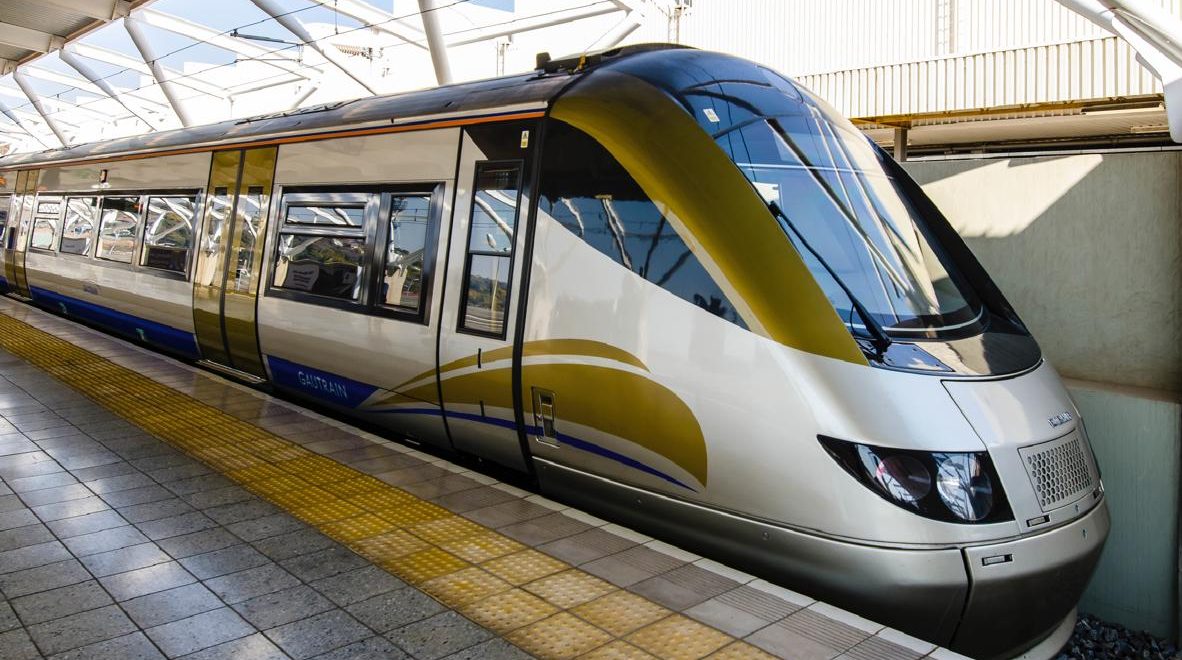
- Gautrain was conceived in the early 2000s as a rapid rail link connecting Pretoria, Johannesburg, and OR Tambo International Airport to ease congestion and modernise public transport in Gauteng.
- The 80km rail system opened in phases between 2010 and 2012 under a public-private partnership with the Bombela Concession Company.
- More than two decades later, the network remains one of South Africa’s most significant transport infrastructure projects as the government prepares the system for its next phase beyond 2026.
The Gautrain has come a long way from a simple idea to becoming a key part of how people travel in Gauteng. Initially suggested in the early 2000s, the goal was to create a modern train line connecting Pretoria, Johannesburg, and OR Tambo International Airport.
The aim was not only to make travel easier but also to support Gauteng’s economic growth. Now, more than 20 years later, the Gautrain is a familiar feature in the province, moving thousands of commuters every day and shaping new developments around its stations.
Origins of the Gautrain vision
The idea for a fast train between Pretoria and Johannesburg emerged at a time when traffic jams on Gauteng’s highways were getting worse, and the province was expanding quickly. Government planners realised that building more roads would not solve the problem of getting around in South Africa’s busiest region.
Early studies explored the need for a new public transport system that would not be affected by road traffic but could still connect important economic areas. A pre-feasibility study, supported by the State of Bavaria in Germany, suggested that the existing transport system needed to be complemented by a rail link capable of carrying people efficiently between the main cities and the airport.
The study found that building another toll road would not be enough and that Gauteng needed a public transport system separate from the roads. The proposed train line would cover about 80km, connecting Pretoria, Johannesburg, and OR Tambo International Airport, with several stations and feeder buses serving local communities.
Planning and decision making
Planning for the Gautrain began in 2000, with the Gauteng Department of Transport and Public Works bringing in experts to assist. They worked on the routes, predicted how many people would use the train, and checked if the numbers made sense. By early 2001, the province had a good idea about possible passenger numbers, costs, and expected revenue.
The government also involved local municipalities, national departments, transport agencies, and international rail companies. The Environmental Impact Assessment included significant public input.
In the end, two main routes were suggested. One would link Pretoria and Johannesburg, while the other would connect Sandton directly to the airport. Importantly, the Gautrain was never meant to replace buses, taxis, or existing trains but to work alongside them.
Construction and launch
Construction started in 2006 after the province signed an agreement with the Bombela Concession Company as part of a public-private partnership. Bombela was responsible for designing, building, financing, and running the rail system for a set period.
The network was built in two phases. The first line connected Sandton, OR Tambo International Airport, and Midrand. The second phase stretched north to Pretoria and Hatfield and south to Park Station in central Johannesburg. The train from Sandton to the airport opened just before the FIFA World Cup in 2010. The line to Pretoria opened in August 2011, and the final section to Park Station was finished in June 2012.
Today, the Gautrain has 10 stations. Trains can reach speeds of up to 160km an hour, taking passengers from Sandton to the airport in about 15 minutes and from Pretoria to Park Station in roughly 35 minutes.
Economic impact and criticism
The Gautrain is one of the largest transport investments ever made by a South African province. The initial cost estimate in 2000 was about R3.5 billion, but the final cost was much higher. Supporters say the Gautrain has helped the economy grow, created jobs, and encouraged new development around stations in areas such as Sandton, Rosebank, and Midrand.
Critics argue that the Gautrain mainly serves middle-class commuters and does not do enough for residents of townships. There have also been debates about the rising costs and how many people actually use the service.
Despite these arguments, more and more people began using the Gautrain after it launched. In the first 100 days, the train had already carried a million passengers. Today, thousands of commuters rely on the Gautrain every day.
Gautrain moves into a new phase
More than a decade after opening, the Gautrain is ready for its next chapter as the agreement with Bombela comes to an end on 27 March 2026. The government has already started looking for a new private partner to operate, maintain, and upgrade the system for another 15 years.
The Gautrain Management Agency says that the system will keep running as a public-private partnership as it moves into this next phase. To make sure passengers are not affected during the handover, the agency has arranged for Bombela to keep operating the system temporarily while negotiations with the new operator are completed.
By the end of the original agreement, the cost of building the Gautrain will be fully paid off. The network will remain a state-owned asset, now worth about R45 billion.
Expansion plans and what’s next
Looking to the future, the Gauteng government wants to expand the Gautrain network to reach even more communities. Possible new routes include extensions to Soweto, Mamelodi, Atteridgeville, Lanseria, and Springs. These plans are part of a larger effort to improve transport and encourage growth in more parts of Gauteng.
Gauteng’s MEC for Roads and Transport, Kedibone Diale Tlabela, says the province is committed to keeping the Gautrain at the heart of the transport system. She says the focus is on ensuring services continue, bringing in private sector expertise, and making sure the Gautrain keeps supporting economic growth, job creation, and better mobility for everyone in Gauteng.

- The Gautrain project was first announced in 2000, several years before South Africa secured the right to host the 2010 FIFA World Cup, positioning the rail system as part of a long-term plan to modernise transport in Gauteng.
- Environmental authorisation was granted on 25 April 2004 after the Gauteng Department of Transport completed an Environmental Impact Assessment for the rapid rail project.
- On 7 December 2005, the government formally approved the project, which was expected to cost more than R24 billion.
- In February 2006, the then finance minister Trevor Manuel announced that R7.1 billion would be allocated from the national fiscus to support the construction of the rail system.
- On 16 February 2006, Gauteng premier at the time, Mbhazima Shilowa, confirmed that the province had reached commercial close with the Bombela Consortium, allowing negotiations toward financial close to proceed.
- The Gauteng provincial government signed a 20-year public-private partnership agreement in 2006 with the Bombela Concession Company, whose shareholders included Murray & Roberts, Bombardier Transportation, Bouygues, and empowerment partners such as Strategic Partners Group.
- Construction officially began on 28 September 2006, triggering significant property and commercial development along the future rail corridor, including offices, shopping centres, residential developments, and entertainment hubs.
- A specialised tunnel boring machine called Imbokodo, built by the German engineering company Herrenknecht, was used to excavate the 6.8m diameter underground tunnels through complex geological conditions.
- The first Gautrain passenger trip took place on 3 February 2009 when about 150 passengers travelled along a 3km test track at the depot.
- Passenger services between OR Tambo International Airport and Sandton opened on 8 June 2010 ahead of the 2010 FIFA World Cup, with later extensions linking Rosebank, Pretoria, Hatfield, and Johannesburg Park Station by 2012.
Get your news on the go. Click here to follow the Conviction WhatsApp channel.
